

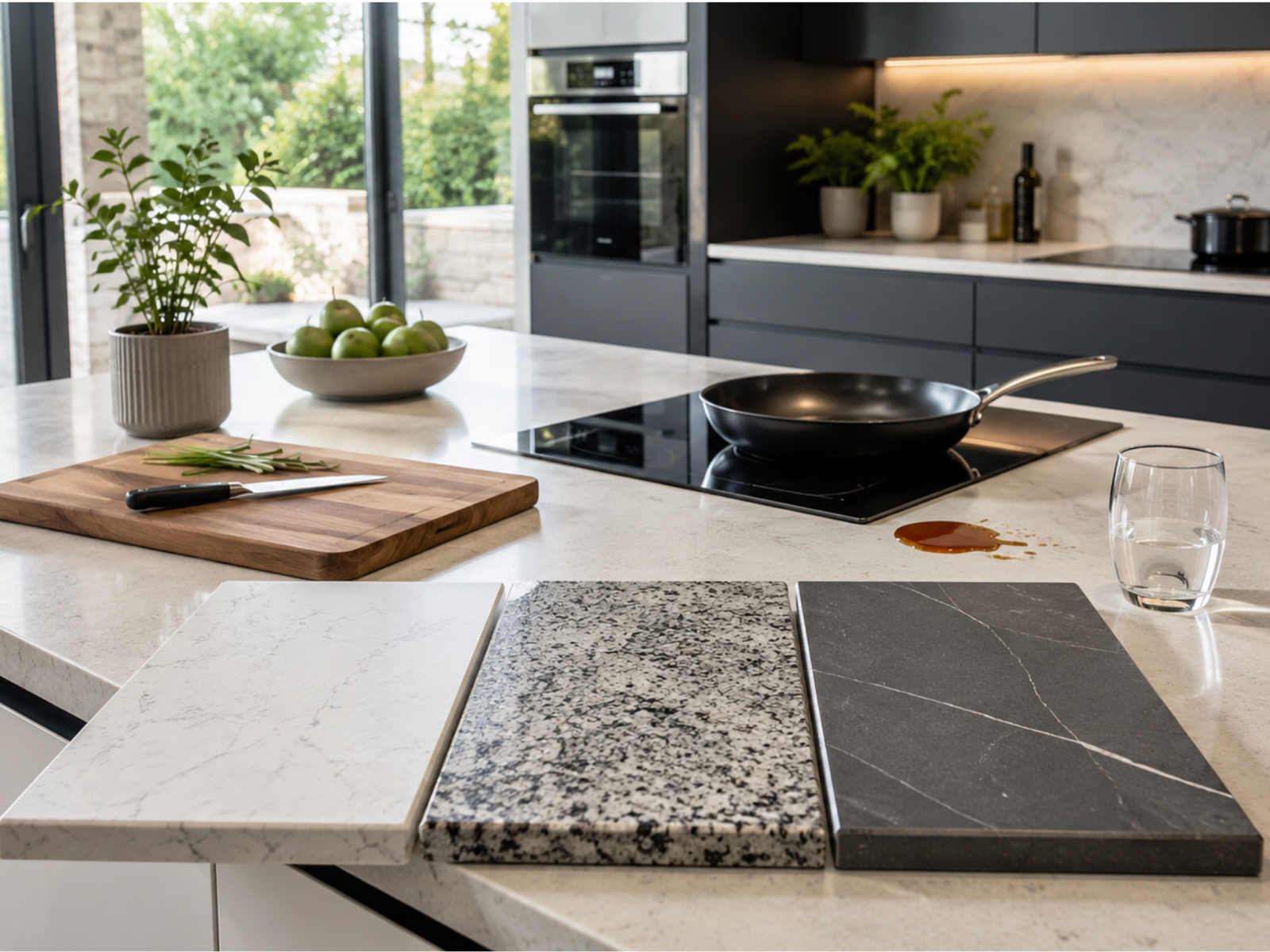
If durability is your main priority when choosing a kitchen worktop, porcelain, granite and quartz are among the strongest options available. Porcelain offers outstanding resistance to heat, scratches and stains, while granite is one of the toughest natural stones you can put in a kitchen. For most everyday homes, however, quartz is often the best all-round durable kitchen worktop material because it combines impressive strength with excellent stain resistance and very little maintenance.
There isn’t one material that wins every durability test. A worktop that handles a hot roasting tray brilliantly may be more vulnerable to an impact on its edge, while another surface may resist stains exceptionally well but need greater protection from high temperatures.
That is why choosing the most durable kitchen worktop should really mean finding the surface that copes best with the way your kitchen is used.
What Actually Makes a Kitchen Worktop Durable?
Durability is about much more than whether a surface feels hard.
A kitchen worktop deals with hot pans, knives, heavy cookware, coffee, wine, cooking oils, cleaning products and constant daily use. A genuinely hard-wearing surface therefore needs to perform well in several areas.
The most important things to consider are:
- Scratch resistance – how easily everyday items can mark the surface
- Heat resistance – how well it handles hot cookware and sudden changes in temperature
- Stain resistance – whether liquids can penetrate or permanently discolour the worktop
- Impact resistance – its ability to cope with dropped cookware and knocks
- Water resistance – particularly around sinks and preparation areas
- Maintenance – whether regular sealing, oiling or specialist treatment is necessary
- Long-term appearance – how well the surface retains its finish after years of use
Looking at durability this way makes comparing worktop materials much easier.
Which Kitchen Worktop Materials Are the Most Durable?
Here is a practical comparison of some of the most common kitchen worktop materials.
| Worktop material | Scratch resistance | Heat resistance | Stain resistance | Maintenance | Overall durability |
|---|---|---|---|---|---|
| Porcelain | Excellent | Excellent | Excellent | Very low | Excellent |
| Granite | Excellent | Excellent | Very good | Moderate | Excellent |
| Quartz | Excellent | Good | Excellent | Very low | Excellent |
| Marble | Moderate | Good | Moderate | Higher | Good |
| Solid surface | Moderate | Moderate | Very good | Low | Good |
| Solid wood | Moderate | Moderate | Moderate | Higher | Moderate |
| Laminate | Moderate | Low | Good | Low | Moderate |
These ratings are useful as a general guide rather than an absolute rule. The quality and thickness of the slab, fabrication, edge design and professional installation can all influence how a finished worktop performs.
Is Porcelain the Most Durable Kitchen Worktop?
From a technical point of view, porcelain is one of the most durable kitchen worktop materials currently available.
Modern porcelain slabs are manufactured at very high temperatures, creating a dense surface with excellent resistance to scratching, staining, heat and moisture.
This makes porcelain particularly attractive for homeowners who cook frequently or want a premium surface requiring very little routine maintenance.
Advantages of porcelain worktops
Porcelain offers several important durability benefits:
- Excellent resistance to high temperatures
- Very strong scratch resistance
- Extremely low water absorption
- Excellent stain resistance
- No routine sealing required
- Easy everyday maintenance
- Good UV resistance
- Suitable for realistic marble, concrete and natural-stone designs
However, there is an important difference between hardness and impact resistance.
Because porcelain is extremely hard, exposed edges and corners can potentially chip if they receive a severe impact from something heavy, such as a cast-iron pan.
For this reason, accurate fabrication and professional installation are particularly important.
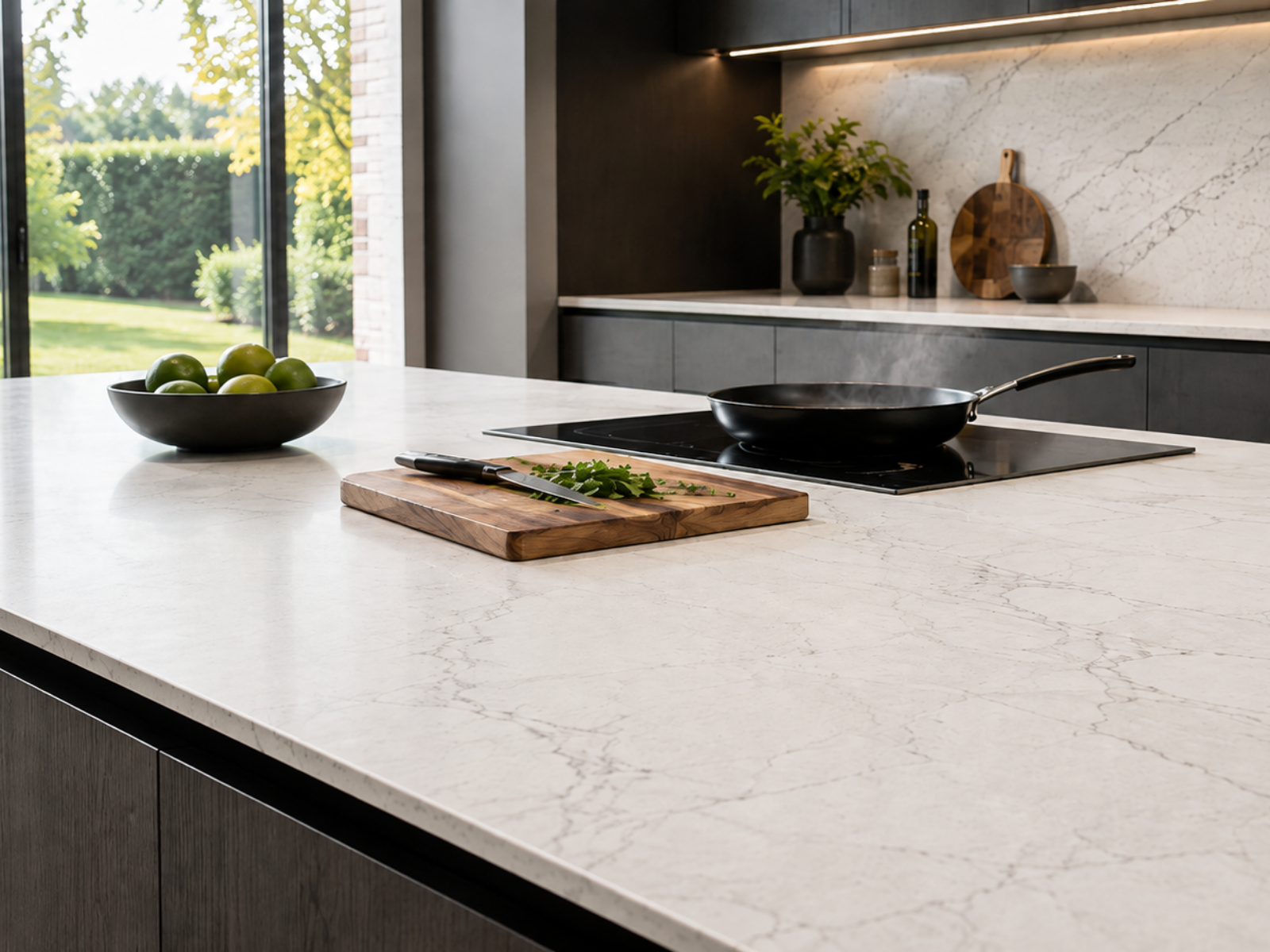
How Durable Are Granite Worktops?
If you prefer natural stone, granite is one of the strongest and most durable kitchen worktop materials available.
Granite is naturally hard and performs extremely well against heat, scratching and general everyday wear. This makes it particularly suitable for busy kitchens where cooking takes place regularly.
Unlike engineered worktops, every slab of granite is naturally formed. This means the pattern, mineral structure and colour variation are unique to each piece.
Where granite performs particularly well
Granite offers:
- Excellent heat resistance
- Very good scratch resistance
- Strong resistance to everyday impact
- Long-term durability
- A naturally hard surface
- Unique colours and mineral patterns
The main consideration with granite is maintenance.
Natural granite has a degree of porosity, which means some varieties may require periodic sealing to help protect the surface against moisture and staining.
If you are comparing different premium stone surfaces, Stone Cut’s guide to quartz, marble and granite worktops can help explain the practical differences between them.
Is Quartz More Durable Than Granite?
Not in every category.
Granite generally performs better when exposed to very high temperatures, while quartz has a significant advantage when it comes to stain resistance and maintenance.
Quartz worktops are engineered using natural quartz minerals combined with pigments and binding materials. The manufacturing process creates a dense, consistent and very low-porosity surface.
As a result, good-quality quartz worktops are highly resistant to everyday stains, scratches and general kitchen wear.
They also do not normally require the routine sealing associated with many natural stones.
Why quartz is such a practical everyday choice
Quartz offers an excellent combination of:
- High scratch resistance
- Excellent stain resistance
- Very low water absorption
- Easy cleaning
- No regular sealing
- Strong everyday durability
- Consistent colour and pattern
- A large range of marble-effect and contemporary designs
This balance is why quartz has become such a popular choice for busy kitchens.
Stone Cut offers a wide selection of quartz worktops, ranging from simple whites and greys to dramatic Calacatta designs and heavily veined marble-effect surfaces.
For a broader explanation of its benefits, the existing Stone Cut guide, Why Choose Quartz Worktops for Your Home?, is also useful for homeowners still comparing materials.
Can You Put Hot Pans Directly on Quartz?
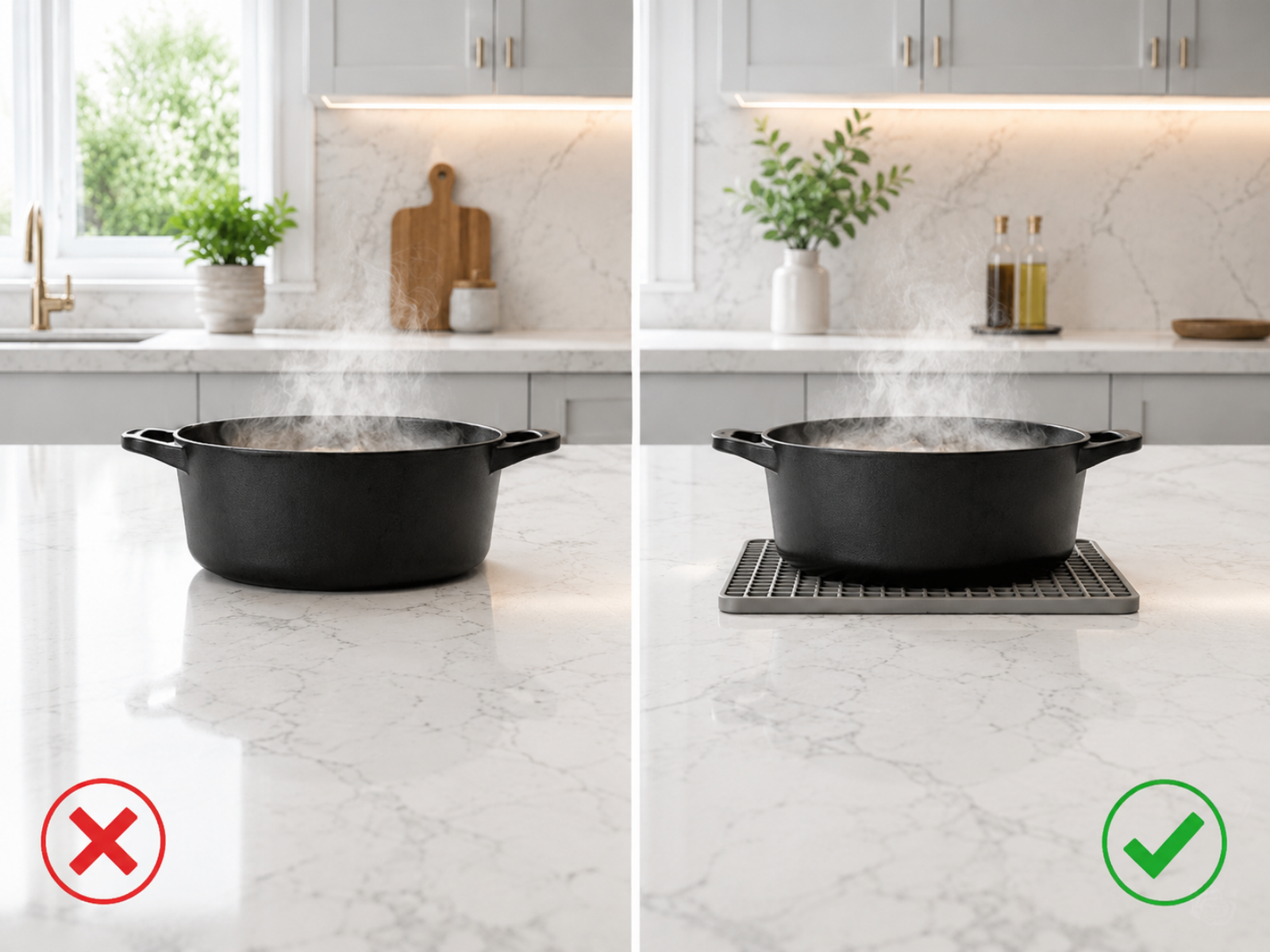
It is better not to.
A common misunderstanding is that because quartz itself is an extremely hard mineral, a finished quartz worktop must also be completely heatproof.
However, engineered quartz worktops contain resins or other binding materials as part of their composition. Very high temperatures or sudden thermal changes can potentially affect these components.
For this reason, manufacturers generally recommend placing very hot cookware on a trivet or heat-resistant mat rather than directly onto the worktop.
That does not mean quartz performs poorly in a kitchen. It simply means sensible protection helps maintain the surface over the long term.
What About Marble Worktops?
Marble can last for decades when properly maintained, but it is not usually the first recommendation for someone whose main priority is maximum resistance to stains and everyday marking.
Natural marble is softer and more porous than granite.
It can also react to acidic substances such as:
- Lemon juice
- Vinegar
- Wine
- Some fruit juices
- Certain household cleaning products
Over time, marble may develop small scratches, etching, staining or changes to its polished finish.
For some homeowners, this ageing process is part of marble’s charm. The surface develops a natural character and patina that makes it feel lived in.
Others prefer a worktop that stays closer to its original appearance.
If you love the appearance of marble but want something easier to maintain, marble-effect quartz can provide a similar visual style with considerably less day-to-day care.
Stone Cut’s guide comparing the quartz marble effect vs real marble can help if you are deciding between the two.
How Durable Are Laminate Kitchen Worktops?
Modern laminate has improved significantly and can provide a very attractive kitchen surface at a much lower initial cost.
However, it generally cannot match quartz, granite or porcelain for long-term durability.
Laminate can cope perfectly well with ordinary kitchen activity, but it is more vulnerable to:
- High temperatures
- Deep scratches
- Heavy impacts
- Water entering damaged edges or joints
- Surface peeling if severely damaged
Laminate may therefore make sense for rental properties, utility rooms, budget-conscious renovations or kitchens expected to be replaced relatively soon.
For a kitchen designed to remain in place for many years, investing in stone or an engineered surface can often provide better long-term performance.
Stone Cut’s laminate vs quartz worktops guide provides a more detailed comparison of these two options.
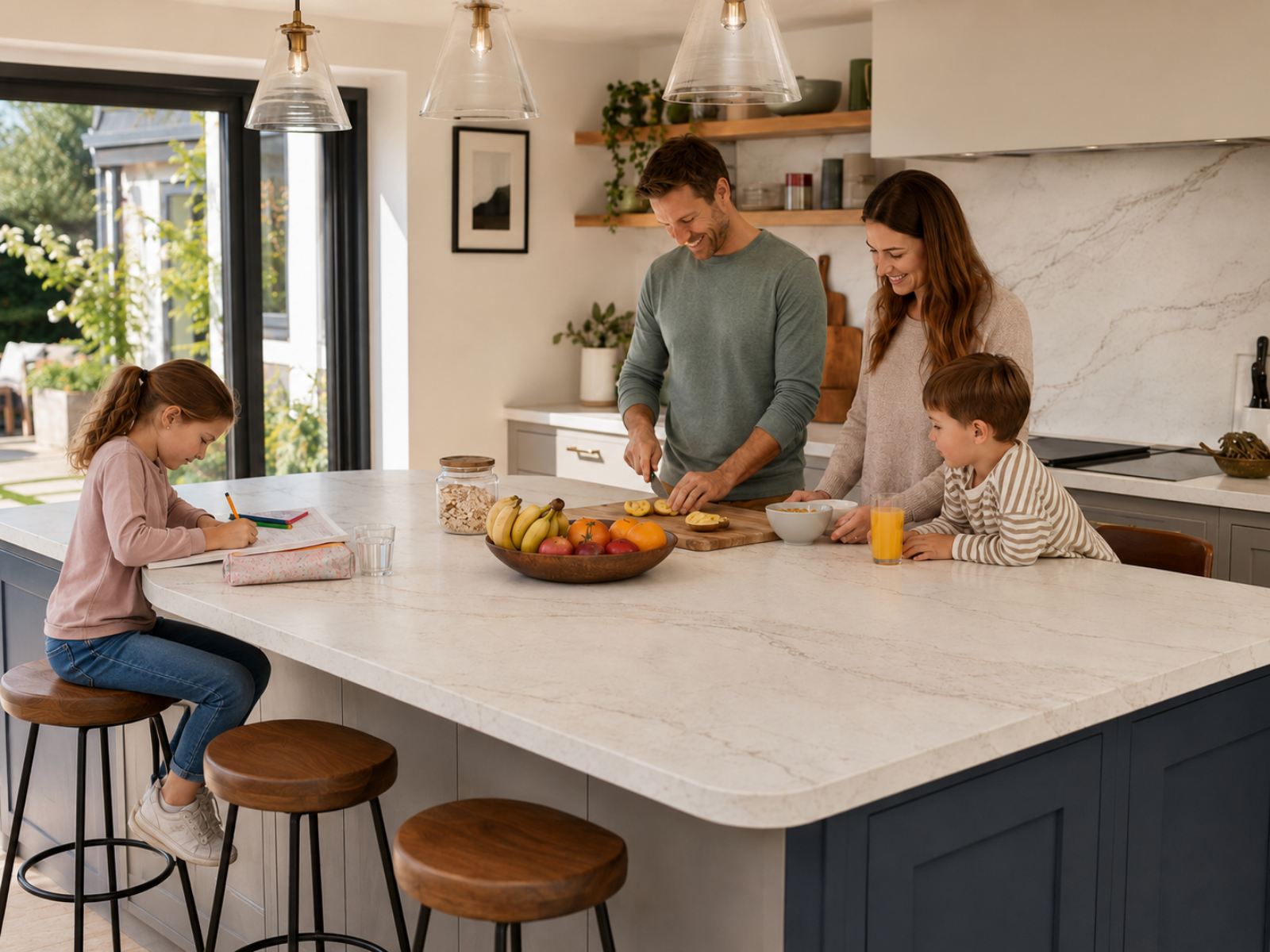
What Is the Best Worktop for a Busy Family Kitchen?
For most busy family homes, quartz provides one of the best combinations of durability and practicality.
A family kitchen has to deal with far more than occasional cooking.
Breakfast is prepared quickly in the morning. Drinks get spilt. Shopping bags are placed on the worktop. Children may use the kitchen island for homework. Sauces splash around the hob, and appliances are moved backwards and forwards throughout the day.
In this environment, a worktop does not simply need to be hard.
It needs to be forgiving.
Quartz works particularly well because everyday liquids do not readily penetrate the surface and cleaning is straightforward.
There are still two simple habits worth following:
- Use a chopping board instead of cutting directly onto the worktop.
- Put extremely hot pans and oven trays on a trivet.
These precautions can help almost any premium worktop maintain its appearance for considerably longer.
What Is the Best Worktop if You Cook a Lot?
If you regularly use heavy cookware, prepare large meals or move extremely hot oven trays around the kitchen, granite or porcelain may be particularly suitable.
Both materials offer excellent heat resistance.
Porcelain is attractive if you want strong heat, scratch and stain resistance together with very little maintenance.
Granite offers similarly impressive durability but with the individuality and natural variation of genuine stone.
Your final decision may therefore depend on whether you prefer the consistent appearance of a manufactured surface or the unique character of natural stone.
Does Worktop Thickness Affect Durability?
Worktop thickness can influence appearance, support requirements and the way certain details are fabricated, although thicker does not automatically mean stronger in every situation.
Quartz, for example, is commonly available in 20 mm and 30 mm thicknesses.
The correct thickness depends on factors such as:
- Kitchen layout
- Island size
- Worktop overhangs
- Edge design
- Cabinet construction
- Sink cut-outs
- Hob cut-outs
- Support underneath the worktop
- The overall style you want to achieve
A correctly fabricated and supported 20 mm quartz worktop can perform extremely well.
Likewise, using a 30 mm slab will not compensate for poor templating, incorrect support or low-quality installation.
Why Professional Fabrication and Installation Matter
Even the most durable slab can experience problems if it has not been measured, fabricated or installed correctly.
Several parts of a kitchen worktop require particular attention, including:
- Sink cut-outs
- Hob cut-outs
- Internal corners
- Worktop joints
- Breakfast bar overhangs
- Waterfall ends
- Unsupported sections
Accurate fabrication helps distribute stress correctly through the material, while professional templating ensures each piece fits the kitchen units and surrounding walls properly.
This is why choosing a kitchen worktop should not be based on the slab alone.
Stone Cut’s kitchen worktop service combines material selection with templating, fabrication and professional fitting so the finished surface is manufactured specifically for the kitchen.
How Can You Make a Kitchen Worktop Last Longer?
Even extremely durable surfaces benefit from sensible everyday care.
Do:
- Wipe up spills reasonably quickly.
- Use chopping boards when preparing food.
- Use trivets underneath extremely hot cookware.
- Clean the surface with products suitable for the material.
- Make sure large overhangs have appropriate support.
- Seal natural stone when recommended.
- Follow the manufacturer’s cleaning guidance.
Avoid:
- Dropping heavy cookware onto exposed corners.
- Cutting directly onto the worktop.
- Using very abrasive cleaning products.
- Using harsh chemicals without checking they are suitable.
- Standing or sitting on unsupported areas of the worktop.
- Leaving water around vulnerable joints for long periods.
- Assuming ‘scratch-resistant’ means ‘completely scratch-proof’.
Choosing a durable material is important, but looking after it correctly is equally important if you want it to remain in excellent condition.
Quartz, Granite or Porcelain: Which Should You Choose?
There is no universally perfect worktop material. The best choice depends on your priorities.
| Your main priority | Material to consider |
|---|---|
| Best all-round everyday durability | Quartz |
| Maximum heat resistance | Porcelain or granite |
| Durable natural stone | Granite |
| Very low maintenance | Quartz or porcelain |
| Excellent stain resistance | Quartz or porcelain |
| Natural and unique appearance | Granite |
| Marble appearance with easier maintenance | Marble-effect quartz |
| Traditional luxury appearance | Granite or marble |
| Busy family kitchen | Quartz |
| Heavy everyday cooking | Granite or porcelain |
For many homeowners, quartz provides the most practical middle ground because it performs extremely well across nearly every category without requiring much maintenance.
Frequently Asked Questions
- What kitchen worktop lasts the longest?
Quartz, granite and porcelain can all remain in excellent condition for many years when they are professionally fabricated, properly installed and looked after correctly. The actual lifespan depends on the quality of the material and how heavily the kitchen is used. - What is the hardest-wearing kitchen worktop?
Porcelain, granite and quartz are among the hardest-wearing options. Porcelain performs exceptionally well against heat, scratching and staining. Granite is an extremely hard natural stone, while quartz provides an excellent balance between durability and low maintenance. - Is quartz better than granite?
Neither material is better in every category. Quartz is easier to maintain and highly resistant to staining, while granite generally performs better against very high temperatures. The right choice depends on your kitchen habits and preferred appearance. - What is the most stain-resistant kitchen worktop?
Quartz and porcelain are both excellent choices because their very low porosity makes it difficult for everyday liquids to penetrate the surface. - Which worktop is best for a family kitchen?
Quartz is particularly well suited to busy family kitchens because it combines excellent stain and scratch resistance with straightforward cleaning and minimal maintenance. - Does quartz scratch easily?
Quality quartz is highly scratch-resistant under normal kitchen use, but it is not completely scratch-proof. Using a chopping board rather than cutting directly on the surface is still recommended. - Is granite more heat-resistant than quartz?
Yes. Granite generally handles very high temperatures better than engineered quartz. Even so, using a trivet is a sensible habit with any premium kitchen worktop.
